Perhaps its most spectacular and spellbinding trait is when amazing sporting fortitude plays out and pays off.
When a footballer pulls a hamstring muscle, they cannot finish a game; when a sprinter jumps the start, they are disqualified; and when a boxer is counted-out, there’s no coming back.
In racing you always fight to the end, not only on track but off it too.
From the ruins of catastrophe can emerge an incredible and powerful phoenix. This is when teamwork truly shines, and when mounting odds are surpassed.
Last month at the 4 Hours of Spa-Francorchamps, Nicolas Jamin and the United Autosports crew took on and conquered all of those challenges.
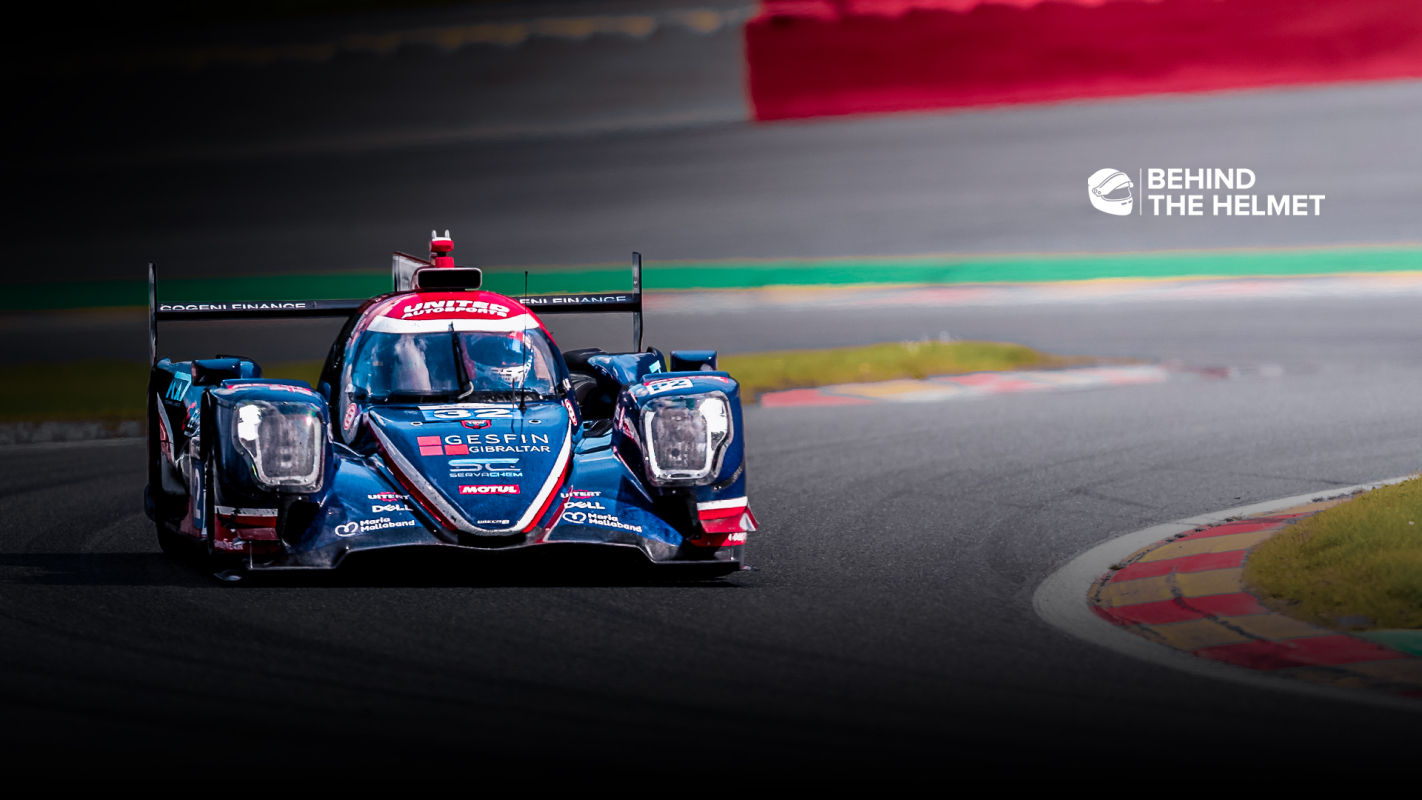
Every race weekend there is someone going off up there at Eau Rouge and Raidillon. Every race weekend you hope it’s not you.
That weekend at Spa, it was me.
In qualifying this corner is high risk but high reward. We were quickest in free practice and the United Autosports team had given us a great car, so I was going for pole and attacking.
The accident I suppose began way before I started the lap.
The LMP3 class qualifying had been stopped for an accident at that exact same place. This meant that there was a delay and in small ways this compromises you because you sit at the pit exit and the tyre pressures drop and everything cools.
Then you must find a place that is clear on the out lap to warm the tyres as much as you can.
I knew the pressures were not so great as I started my quali lap because we get them displayed on the dash. But I decided to go flat in to Eau Rouge.
The car is always on the edge of bottoming at this corner and with the pressures they were, I went a little wider after the right-hander and then used more of the kerb at the top than I normally would.
The car basically skated on the separation of the track and the kerb, so the rear wheels were not touching the ground anymore. That’s when the rear was lost.
You are always trying to save it but at that speed there is not that much you can do. At the point where you know you are going to hit the wall you take your hands off the steering wheel, and you just wait.
Before you know anything, the medical crew is jumping around the car wanting to know if you are ok. I knew immediately I was alright and the first thing I did was talk to my engineer to confirm I was.
I was mad when I got out of the car because I really felt we were going to get pole. It was a tough one for me to swallow and it took me a few hours to say ‘ok, now we need to forget about this and look forward.’
What makes that easier is my team and my teammates, Job (van Uitert) and Manuel (Maldonado) being great about everything.
They are real racers and I especially remember my mechanic Romain (Gonidou) saying ‘Nico, we are going to charge to the front tomorrow.’
This is incredible because at this stage we basically didn’t have a car!
There are very few situations that Trevor Foster has not come across in motorsport. Last year he began his sixth decade in motorsport and he continues to be a formidable asset now for United Autosports multi-championship operation.
He’s worked with Michael Schumacher, Johnny Herbert, Jean Alesi and Damon Hill, so Foster knows how to run a successful operation and work with top drivers.
As he explains, keeping calm in the face of adversity is a major part of winning the battle:
"The first instinct when you are watching the accident on the screens is always ‘is the driver safe, are they ok?’?
The car is a secondary issue at that point because Nico is the complete priority.
Thankfully he was fine. So, then you immediately start to focus on the car and the overriding attention is then on the tub (monocoque).
If the tub is ok, you can rebuild around the basic core, but you never know until you inspect it properly and it took a while for the car to come back to the parc ferme area and then it must be released back to us.
The spine of the car is the tub, the engine and the gearbox, these are the major components and where you start to plan the rebuild.
On the engine side we must get Gibson involved but we can make a call on the gearbox ourselves.
We could see clearly that the suspension mount had been broken off and that the main case was cracked around the top left-hand rocker post, so therefore we knew quickly we needed to change the gearbox.
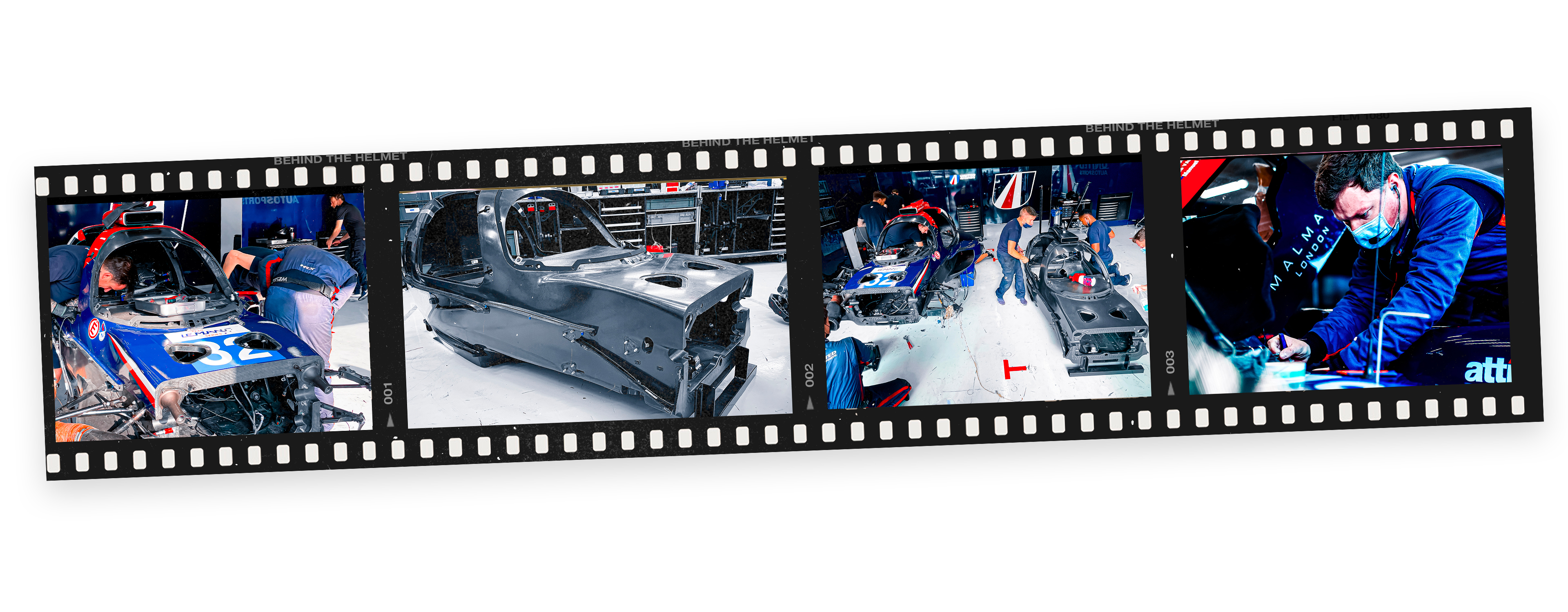
At the same time, we were taking the bodywork and suspension parts off the tub and concurrently we have people making lists for replacement parts.
We also have a freight guy (James Foster) who doubles up as part of pit crew and his job is to look at the ‘lifing’ list, what spares we've got, what mileage they've done, etc.
By around 17.00 local time we knew the tub was damaged and we already had a secondary list of parts we needed direct from ORECA too. We were working quickly but also methodically because there was so much to do, but at the same time you must make sure it is done right.
We've never been in the position to have a spare tub built-up and ready to go as an emergency spare.
But ironically, we had one just delivered to us at Spa as a replacement for the one that was damaged at Le Mans, but it was absolutely a bare chassis, nothing on it at all.
You then go through a process of stripping out the damaged tab; the fuel cell, all the wiring looms, the ancillary equipment inside the chassis.
At the same time, we're also looking at the steering rack, the steering column and loads more things too after such a major impact. We put parts in to quarantine and when we get back to the UK, we need to get it NDT (non-destructive testing for quality control) tested properly.
Gibson had a bit of a conference about the engine and said that the old pump and the coil pack was damaged. They decided to play it safe and asked us to change the engine, so we took the engine off.
The spare gearbox and all the ancillary equipment were prepared, so we were ready when we got the new engine. This meant that when the tub was ready, the rear end would be built up and be ‘dressed’ ready to go.
There are so many electrical looms that you've got to be so careful about how you put them in a new tub.
Often some minor problem with electronics is probably the achilles-heel of stopping you in a race, and when you’ve worked so long and hard, that can be soul destroying. So, we work very methodically and carefully.
I know that Nico’s primary feeling, and instinct was to help the guys. This is normal but you can only get so many people around the car.
It’s easy to say ‘oh just get more people involved’ but you can't because you must use the space in the garage efficiently and the chances are there will be a bigger chance of making mistakes if you don’t organise things carefully.
Just keeping calm and going through the work to list and keeping people going is key. You don't have to motivate our team; they're already motivated and working as a team. That is a pre-requisite of the job whatever the circumstances.
It's important that you also have pride that you want the car to look right when you roll it out of the pit box. It needs to look as good as it ever looked and not something that has been rushed. As the tub was brand new, we had to vinyl it all again with a fresh livery.
There was also the paperwork with the stewards and the technical scrutineers because you must get the technical checks done again because it is a new car. I have to say that they were very accommodating on the timing of when we did this, which was very much appreciated.
We were able to get a shower back at the hotel at around 7am which was at least something.
But you never hear anyone moan in this team. There was a great hunger to see the job through at every stage of the rebuild even though we knew there would be no sleep."
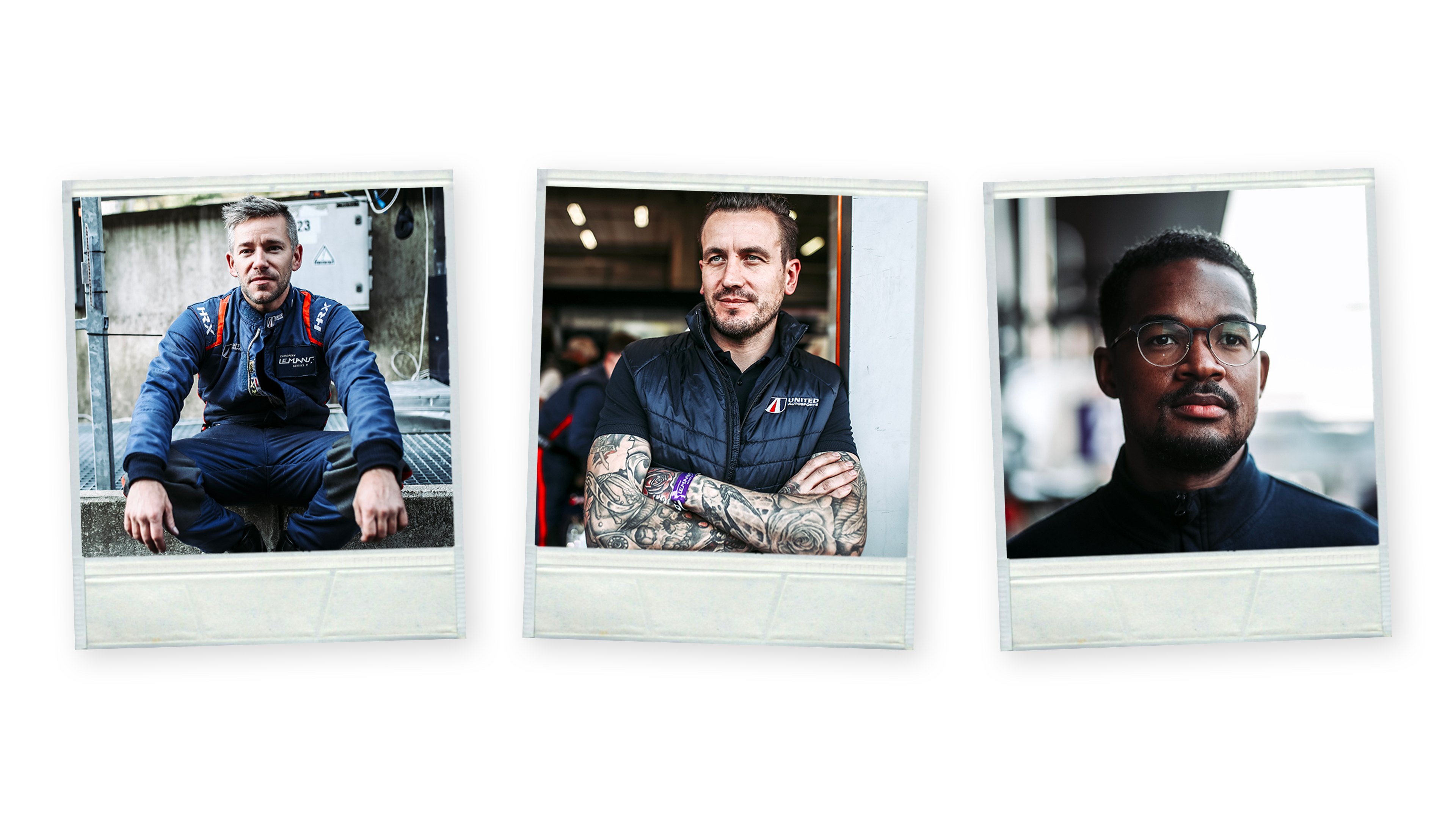
"Those who didn’t get a wink were: Marc Scaife - number 1 mechanic, Gaz Munford - number 2 mechanic, Kenji Concy - number 2 mechanic, Ben Ancil - number 2 mechanic, Josh Billingham - data engineer and parts organisation/rotation, Joel Bradley – graphics and Johan Mace - mechanic from the No.22 car, who stayed to help!"
"There was a lot of extra motivation bubbling in me that night and when Sunday came, I was really up for it.
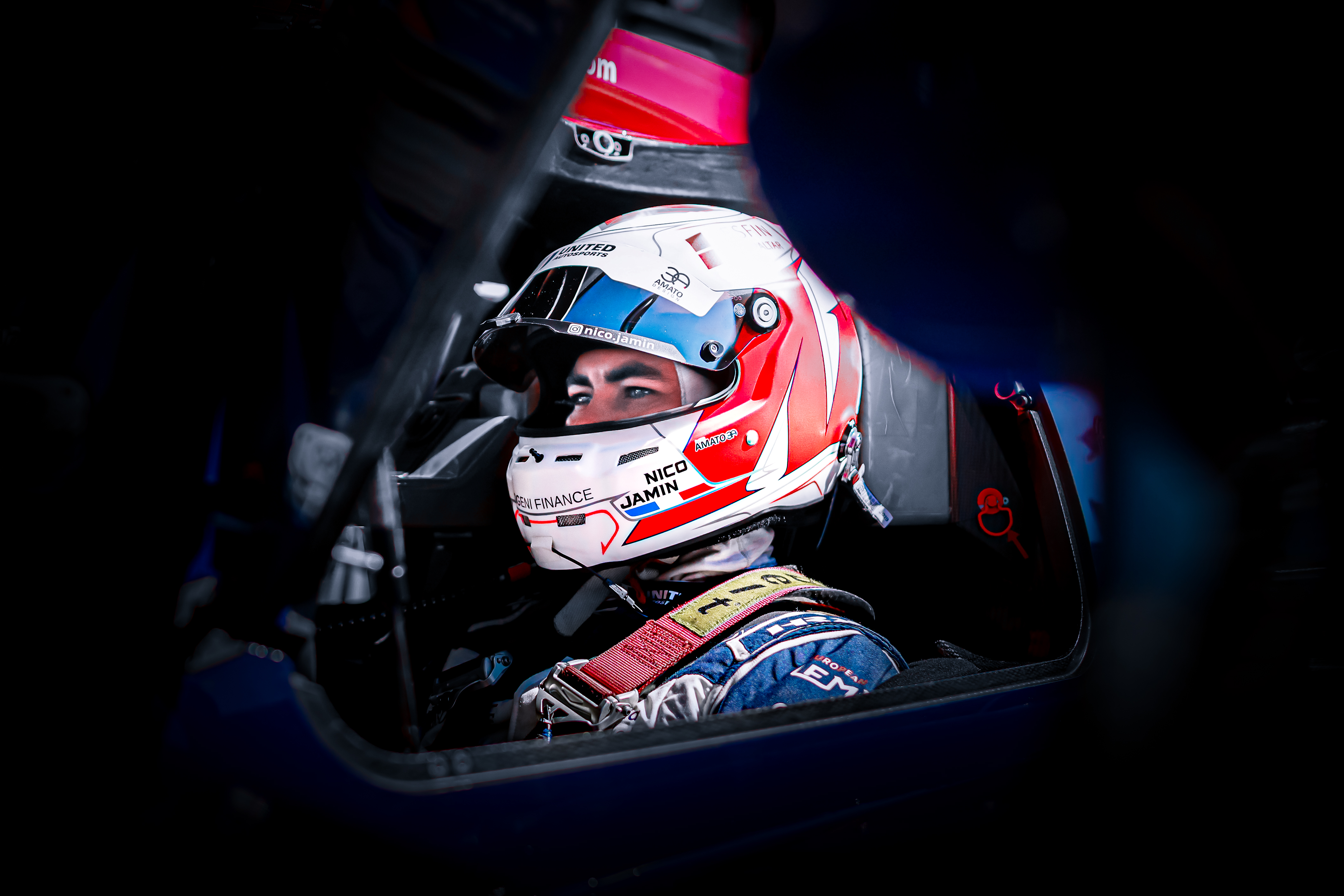
Initially we planned to have Manuel starting the car but then the team received a bulletin late at night saying that the fastest driver had to start, so I knew then that I would be the first person to turn a wheel in the new car.
I can’t tell you how good it felt as I left the pits. This team had been working for 17 hours non-stop and the car felt completely fresh, just like it had prior to the crash. That’s quite mind-blowing when you think about it."
"We had the pace to win I’m sure of it. But you know, racing can be a strange business and unpredictable as we know.
We were quick, and we were soon near the front after starting right at the back. But when things aren’t meant to be they really aren’t meant to be.
I was racing with Richard Bradley for P3, and we braked together at the last chicane and there was slight contact. The stewards decided to give us a penalty and let’s just say I thought this was harsh, very harsh.
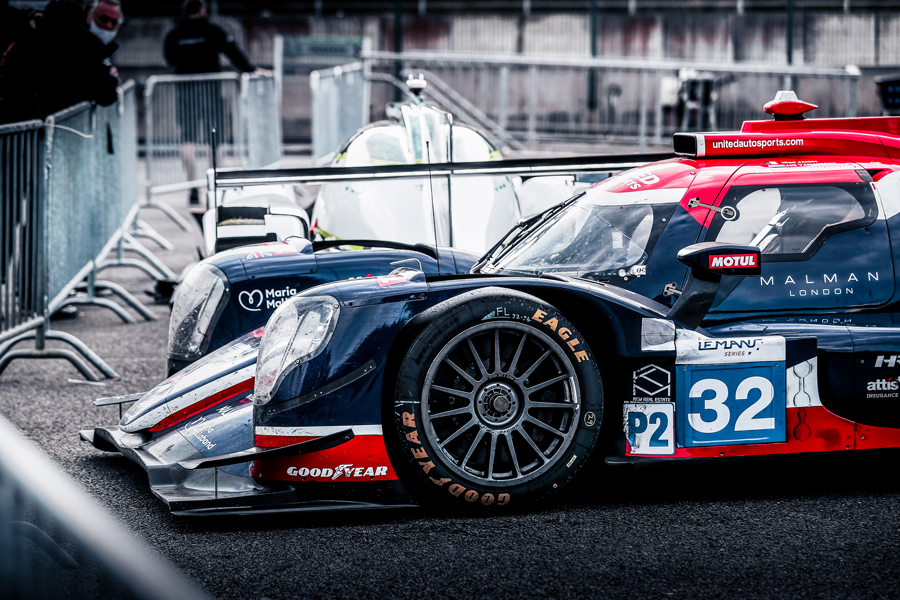
Anyway, this was the first setback and we dropped to 13th, but we never say die at United Autosports and we came back super strong again.
We always knew that doing the race on two and a half sets of tyres would be tough because we lost a set in the crash. Job did a nice job and so did Manuel, but he had no tyres left at the end and we just couldn’t quite fight for a podium and ended up in fifth place.
On one hand we had really high expectations which we always set ourselves but on the other we are disappointed to be fifth.
Still, when I got out of the car after my stints, and we had run in second place was extra special. I could just see smiles on everyone’s faces and they were giving me fist bumps and thanking me for what I did on track.
It was something so special and a big relief for me. 24 hours earlier it was a very different story and every person in that team must be super, super proud of what they all did that weekend."